
As you may know, January 1st The Working Families Tax Cut Act, signed into law on July 4, 2025, created new requirements for individuals applying for or enrolled in Medicaid expansion programs (aged 19-64) to participate in work or community engagement activities. These requirements take effect January 1, 2027, for new applicants, and at the time of a current beneficiary’s first renewal after January 1, 2027.
It will be up to each state to interpret the rules into the systems. Each state should have a list of conditions considered “medically frail” that will be exempt from the community’s engagement/work requirements.
Please check with your state department of health and human services to find out specific information for your state.
In my home state, New Hampshire, the DHHS-NH is accepting public comments on how the rules will be applied and what conditions are included as medically frail and/or complex conditions based on ICD-10 codes.
I was able to attend an information session and file an application for CRPS Types 1 and 2 to be added to that list. If the most painful disease known to medicine is not on this list, I don’t know what is. The following is information to help you submit similar requests in your home state.
Together we can ensure no CRPS ever goes unnoticed again. Silent no more.
———————————————————————————————————–
Information about the medically frail exclusion to the Medicaid work/community engagement requirement
An individual may be excluded from the work/community engagement requirements due to medical frailty if they have a physical, mental, or behavioral health condition that significantly impairs their ability to comply and meet one of the following criteria:
1. Is blind or disabled;
2. Has a substance use disorder (excluding individuals in stable recovery of 5 or more years);
3. Has a disabling mental disorder;
4 Has a physical, intellectual, or developmental disability that significantly impairs their ability to perform one or more activities of daily living; or
5. Has a serious or complex medical condition that is life threatening; seriously disabling even if not life threatening; causes significant pain or discomfort that interrupts daily life; requires substantial caregiver involvement; requires frequent monitoring; is associated with severe clinical or social consequences; affects multiple organ systems; requires tight physiological management; requires coordination across multiple specialties; involves treatment that carries risk of serious complications; or requires adjustments in non medical environments.
As required by 42 C.F.R. 435.557, the Department must review all reliable information available to the state, including Medicaid claims adjudicated in the preceding 12 months. In accordance with 42 C.F.R. 435.554(c)(5)(ii), the Department has developed a list of diseases, diagnoses, disorders, and other health conditions that identify individuals who meet medically frail exclusion criteria. The methodology also includes a process for individuals to request exclusion if their condition is not reflected on the list.
Guide: Adding Complex Regional Pain Syndrome (CRPS) to the Medical Frailty Exception
1. Submitter Information
Name:
Email:
Phone: If you are comfortable giving it
Organization: If associated with one
Role: Advocate or Organization Representative
2. Nature of the Submission & Important Filing Rule
Comment Type: A condition that is not on the current list.
Category Fit: Serious or complex medical condition.
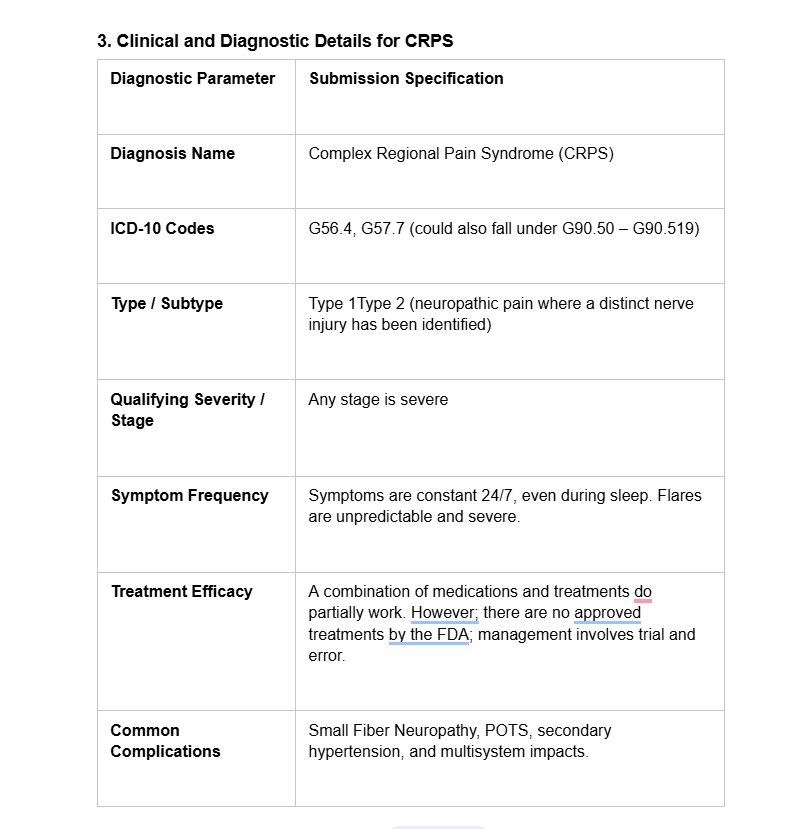
Submission Requirement: You must submit twice—complete one full public comment submission for Type 1 and a separate, second submission for Type 2 to ensure both classifications of the syndrome are officially reviewed and documented.
4. Ongoing Care and Daily Life Impacts
Ongoing Care Need
Daily medication and heavy pharmacotherapy (including opioids/narcotics or ketamine infusions).
Frequent specialist visits and ongoing medical interventions.
Home health or personal care support.
Impact on Daily Life
Severe difficulty with bathing, dressing, or using the toilet (e.g., water contact can feel like severe needles).
Impairments in walking, standing, or moving around independently.
Challenges with managing medications, medical care, working, or attending school.
5. Justification for Medical Frailty Exception
Complex Regional Pain Syndrome (CRPS) is widely recognized as the most painful chronic condition known to medicine. It involves profound nerve injury—either undiagnosed (Type I) or clearly identified (Type II)—accompanied by severe autonomic changes (such as vasomotor abnormalities and sweating), motor changes (weakness, dystonia), and trophic tissue impacts.
Because there are no FDA-approved treatments, patients undergo exhausting trial-and-error regimens that heavily tax physical and emotional well-being. The constant, unremitting pain leads to extreme psychological and physical vulnerability, severely impairing a patient’s capacity to engage in daily activities without substantial assistance. Recognizing CRPS under the medical frailty exception ensures vulnerable patients receive the safety-net protections and ongoing care coordination they need.